God Bless America!
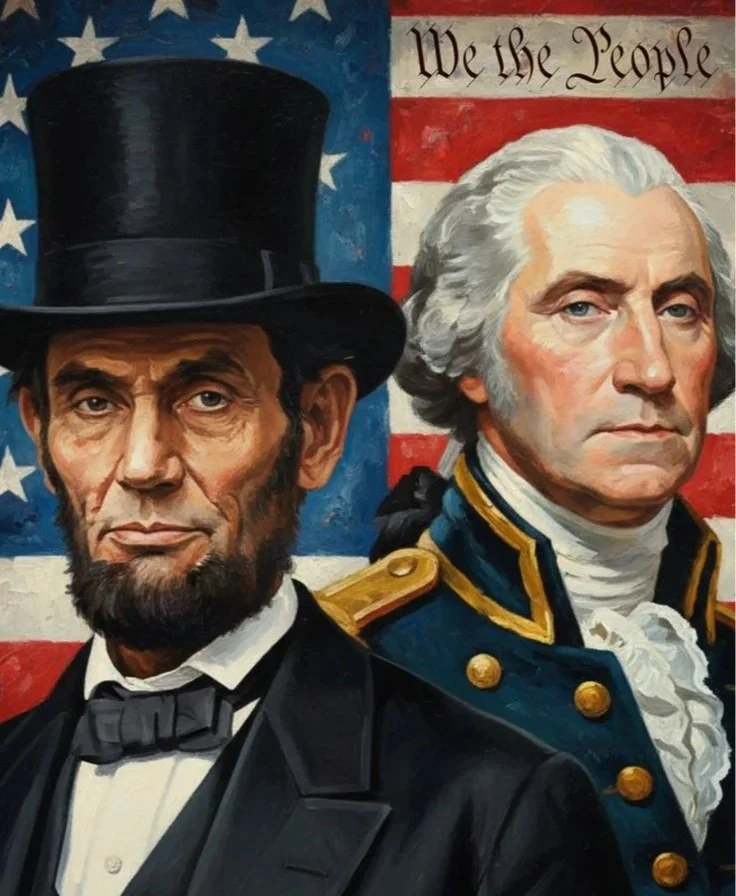
During the early 1960’s when I was a little girl at Garfield Elementary School in Boise, Idaho, I always looked forward to February because we studied and celebrated the lives of two of our past amazing presidents who led such exemplary lives—George Washington and Abraham Lincoln. On each of these birthdays, we also had a day off from school!
This tradition continued through my years at East Junior High and Boise High School. However, this all changed in 1971, the year after I graduated from high school, when the “Uniform Monday Holiday Act” became effective. Now, the 3rd Monday in February, which is a Federal Holiday, is called “Washington’s Birthday” or “President’s Day” for those who recognize and celebrate the lives of both Washington and Lincoln, which I like to do!
George Washington was born on February 22, 1732, and died December 14, 1799, from a severe illness. He served as our 1st President of the United States of America from 1789 – 1797.
Abraham Lincoln was born on February 12, 1809, and died on April 15, 1865, from an assassin’s bullet. He served as the 16th President of the United States of America from 1861-1865.
Both Washington and Lincoln were my childhood heroes when I grew up—and not just because I got a day off from school—but because of their lives of hard work, self-discipline, sacrifice, and duty to country always rang true to my heart. I have always believed that they were being guided by God.
In a talk entitled, “God’s Hand in Our Nation’s History” by Ezra Taft Benson, which was given on March 28, 1977, he quotes these two presidents:
“The success which has hitherto attended our united efforts, we owe to the gracious interposition of heaven, and to that interposition let us gratefully ascribe the praise of victory and the blessings of peace.”
“We have forgotten God. We have forgotten the gracious hand which preserved us in peace and multiplied and enriched and strengthened us, and we have vainly imagined in the deceitfulness of our hearts that all these blessings were produced by some superior wisdom and virtue of our own. Intoxicated with unbroken success, we have become too self-sufficient to feel the necessity of redeeming and preserving grace, too proud to pray to the God who made us.”
Ezra Taft Benson concludes with these inspiring words of his own:
I bear witness to you that America’s history was foreknown to God; that His divine intervention and merciful providence have given us both peace and prosperity in this beloved land; that through His omniscience and benevolent design, He selected and sent some of His choicest spirits to lay the foundation of our government. These men were inspired of God to do the work which they accomplished.
My concern is that we don’t give Washington and Lincoln, and other exceptional Presidents and Vice-Presidents of the United States the recognition they deserve. We are in great need of trustworthy leaders who are positive role models—both women and men—to whom we can look up to and emulate.
As individuals, or as we teach our children within our families, we can make positive changes by implementing characteristics of people who have lived their lives with high moral principles. We will have more confidence in our decisions, and our families will be blessed and strengthened as we joyfully do these things. Happiness and high self-esteem come through intentionally seeking the ideal and refusing to blame problems on anything that is going on around us.
George Washington once said in a letter to his mother, “…happiness depends more upon the internal frame of a person’s own mind—than on the externals in the world.”
I like to look for inspiring people with integrity, so I’ve always appreciated this quote from Abraham Lincoln: "Stand with anybody that stands right, stand with him while he is right and part with him when he goes wrong."
While neither Washington nor Lincoln were perfect, they continued to make changes over the years. For example, Washington did own slaves. However, by the end of his life, he felt strongly that this was wrong and wanted to free his slaves. He called it a “subject of regret.”
Lincoln was also willing to think, ponder, and do things differently when he felt that he should. He said, “Holding it a sound maxim that it is better only sometimes to be right than at all times to be wrong, so soon as I discover my opinions to be erroneous, I shall be ready to renounce them.”
I hope that we will take the time to study the extraordinary lives of both George Washington and Abraham Lincoln and put into practice their admirable qualities—not only in February—but throughout the whole year!
God bless America!